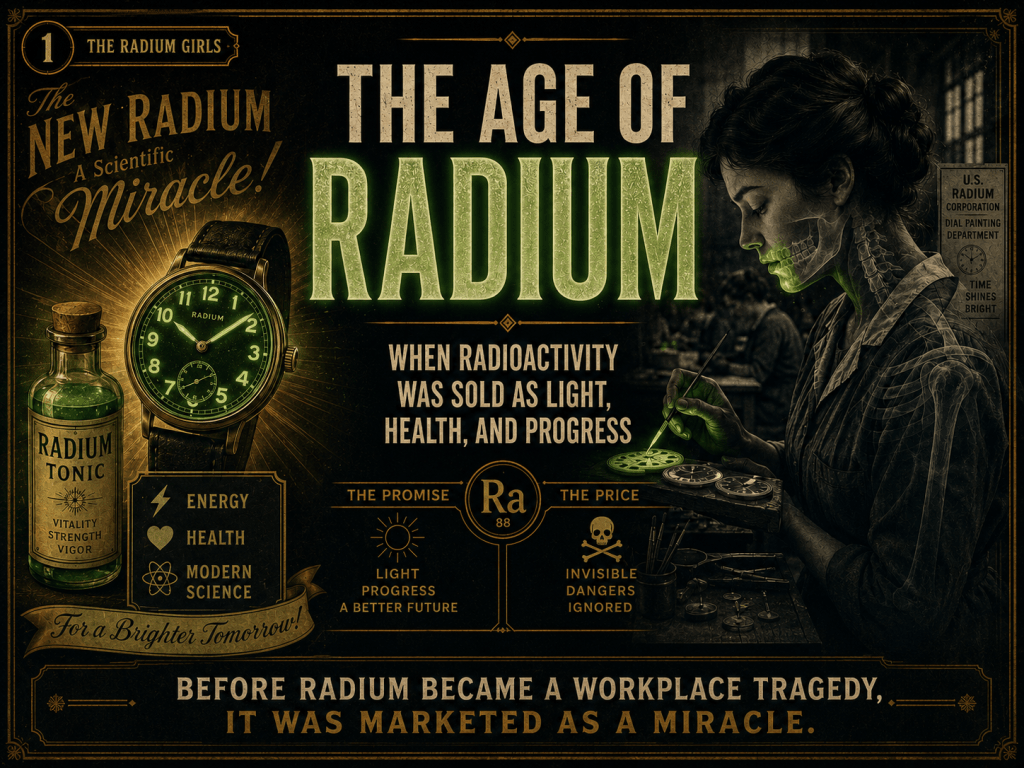
1. Radium as a Promise
At the end of the nineteenth and the beginning of the twentieth century, radium was not first perceived as a danger. It appeared in culture as a symbol of the new science – a substance that glowed, released energy, and seemed to violate ordinary ideas about matter. After its discovery by Marie and Pierre Curie in 1898, radium quickly became not only a scientific object but also a public myth: a material sign that modern physics and chemistry were entering the invisible depths of nature [1].
This fascination was not entirely irrational. Radium really is an extraordinary element. Its radioactivity is real, measurable, and scientifically revolutionary. The work of Curie, Becquerel, and other researchers opened a new era in the understanding of the atom, energy, and radiation. In medicine, radioactive substances began to be studied as possible therapeutic agents, especially for some tumors. For that reason, the early interest in radium should not be presented simply as foolishness or superstition. The problem begins where limited scientific knowledge becomes a commercial promise.
In this period, the boundary between laboratory, clinic, advertising, and market was dangerously blurred. Radium began to appear in products that promised vitality, beauty, energy, and health. Radioactivity was advertised not as a risk, but as a modern force that could “stimulate” the body. Later, one of the most famous examples of this culture would become Radithor – radioactive water containing radium-226 and radium-228, sold as a medicinal tonic [2]. The case of Eben Byers, a wealthy American industrialist and athlete, shows how dangerous such faith can be when radioactivity is taken internally as a health product [3].
This context matters because the Radium Girls were not an isolated accident. They were part of a broader radium age, in which society was ready to see radioactivity as a promise before it fully understood its biological cost. When radium began to be used in luminous paints for watches and instruments, it already carried the aura of a scientific miracle. The glowing dial looked like a small technological triumph: practical, beautiful, modern, and useful.
But this is exactly where the central tension of the story begins. For the consumer, radium paint meant convenience – a watch that could be seen in the dark. For the military and industry, it meant functionality, efficiency, and market value. For the women who applied the paint by hand, it gradually became an internal source of radiation. Radium began as a promise of light, but for them that light entered the bones.
The story of the Radium Girls, therefore, is not a story against science. It is a story against the premature transformation of science into advertising, against the industrial transfer of risk, and against society’s tendency to call something “progress” before its cost has been measured.
2. Radithor and Radioactivity as a Product
To understand why the Radium Girls were assured that they were working with a safe material, we need to see the broader cultural environment of the time. In the first decades of the twentieth century, radioactivity was not perceived only as a laboratory phenomenon or a medical instrument. It had been turned into a commercial language. Radium was advertised as a source of vitality, rejuvenation, energy, and health. This does not mean that everyone understood the risk equally poorly. It means that the market very quickly turned incomplete scientific knowledge into a promise.
One of the best-known examples is Radithor – radioactive water sold by Bailey Radium Laboratories in the 1920s. The product consisted of a small bottle of triple-distilled water, guaranteed to contain at least 1 microcurie of radium-226 and 1 microcurie of radium-228 [5]. This is an important clarification, because Radithor was not merely symbolic “radioactive” advertising. It actually contained radioactive isotopes of radium.
Radithor was advertised as a remedy for fatigue, weakness, pain, sexual impotence, and a wide range of other conditions. In the medical literature, the case is described as part of so-called “mild radium therapy” – a therapeutic philosophy in which small amounts of radium and its decay products were taken orally or introduced into the body with the idea that they could stimulate physiological processes [6]. Here we see a dangerous historical pattern: a real scientific discovery is detached from the strict laboratory and clinical context and transformed into a universal market metaphor – “radiation = energy = health.”
The best-known victim of Radithor is Eben Byers – a wealthy American industrialist, athlete, and former amateur golf champion. After an injury, he began taking Radithor on a physician’s recommendation and gradually reached a state of chronic, severe internal exposure. According to historical accounts, Byers used the product for a prolonged period, often several bottles per day. At first he felt “stimulated,” but later developed severe damage: tooth loss, destruction of the jaw, bone lesions, and progressive systemic disease [5].
Byers’s case is important, but it must be used carefully. It should not turn the story into a sensational account of “the man whose jaw fell off.” Its real meaning is different: it shows how radioactivity was sold as a health product in a society where regulation still lacked sufficient power to stop dangerous but formally labeled products. Later, the FDA noted that the early law of 1906 had serious weaknesses: it required truthful labeling, but gave limited options for removing dangerous products from the market, especially when they were not formally “misbranded” under the criteria of the time [7].
This is where Radithor becomes useful as an introduction to the Radium Girls. It shows that radium was not only an industrial material but also a cultural product. Radioactivity was sold as modernity. When young women in luminous dial factories were assured that radium paint was safe, that did not sound absurd in the context of the time. It sounded like part of a broader public belief: that radium was a new force of science, and that new science, by definition, brought progress.
The difference, however, is essential. Eben Byers was a wealthy consumer who purchased a radioactive product. The Radium Girls were workers placed in a production environment where the risk was systematically transferred onto their bodies. In Byers’s case, the tragedy revealed the danger of radioactivity as a medical and consumer myth. In the Radium Girls’ case, that same myth became industrial exploitation. Radithor, therefore, should not be a separate side story in this article, but a short, strong historical bridge: from radium as a promise to radium as an occupational disease.
So the point is not simply that people once believed in strange “healing” products. The deeper question is how society decides what is safe when the science is new, regulation is weak, and advertising speaks louder than biology.
3. Luminous Dials
Once radium had already been surrounded by a cultural aura of modernity, it quickly found a practical industrial application. One of the most important was radioluminescent paint – a mixture in which radioactive radium excited a phosphorescent material, most often zinc sulfide, thereby producing a glow in the dark [8]. This technology had an enormous advantage for its time: it required no battery, external lighting, or electrical power. The material itself produced a constant light effect.
At first glance, this looks like a small but brilliant technological breakthrough. A watch, compass, or aviation instrument that could be read in the dark had obvious practical value. During the First World War, such luminous instruments were especially useful for military purposes – in night navigation, aircraft, ships, trenches, and situations in which bright light could be dangerous or undesirable [9]. After the war, the same technology moved into the civilian market. The luminous watch was no longer only a military instrument, but a modern consumer product.
Radium paint therefore stood at the intersection of war, industry, and consumption. It was useful enough to be demanded by the military; striking enough to be desired by consumers; and profitable enough to create a new production sector. In the United States, the United States Radium Corporation and its associated predecessor structures developed production in Orange, New Jersey, while later similar activities appeared in Ottawa, Illinois, and Waterbury, Connecticut [10].
But the technological elegance of the luminous dial concealed the reality of production. Applying the paint was not an automated, distant, or well-protected process. It was done by hand, with small brushes, on fine numerals, hands, and markings. The work required a steady hand, vision, patience, and speed. For this reason, factories hired mostly young women, who painted dial after dial, day after day, often paid according to the number of finished pieces [11].
Here the real asymmetry begins. For the customer, the glow was convenience. For the military, it was functionality. For the company, it was a product. But for the workers, radium paint was an everyday material found on brushes, hands, worktables, clothing, and sometimes in their mouths. What looked like light on a watch gradually became invisible exposure inside the bodies of the people who produced that light.
It is important to emphasize: the problem was not simply that radium paint existed. The problem was that a genuinely useful technology was organized in such a way that the risk fell on the least protected part of the production chain. Radium was expensive, scientifically impressive, and industrially valuable. The workers were cheap, replaceable, and poorly informed labor. That was the social formula of the catastrophe.
For that reason, the luminous dial should be described not only as an object, but as a system. Inside it were chemistry, physics, war, market, advertising, and labor. It was precisely this system that transformed radium from a symbol of progress into an occupational danger.
4. “Lip, Dip, Paint”: The Gesture That Turned Paint into an Internal Dose
The most dangerous moment in the work of the dial painters did not look dangerous. It was a small, repeated, almost mechanical gesture: the brush was shaped with the lips, dipped into the paint, and applied to the dial. Later, this practice became known as “lip, dip, paint” – lips, paint, dial. It was used because the numerals and markings on the watches were very fine, and the brush had to keep a sharp point constantly [12].
Here it is important to be precise. The workers were not “swallowing pure radiation.” They were swallowing microscopic amounts of radium paint – a material containing radioactive radium. Radiation is not a substance that can be eaten; radium is the substance that, after being swallowed, continues to emit radiation inside the body. This distinction is essential for the scientific accuracy of the topic.
From the perspective of production, lip-pointing looked like an efficient technique. The lips and tongue shaped the brush more finely than cloth or fingers; this allowed the workers to paint faster and more precisely. But from a biological perspective, this was a catastrophic interface between an industrial material and the human body. Each shaping of the brush left a small amount of paint in the mouth. A single dose might seem negligible. But with hundreds of repetitions per day, week after week, month after month, it became chronic internal intake of radium [13].
This detail makes the case so important for the history of toxicology and radiation protection. The danger was not only in the presence of radioactive material in the workplace. The danger was in the way the organization of work created an exposure pathway. If radium paint remains outside the body, the risk is one thing. If it is swallowed, the risk becomes something entirely different. The body is no longer only an external observer of the danger; it becomes the place where the radioactive source is located.
The workers were often young, poorly paid, and dependent on the employer’s instructions. They were not in a position to assess the radiobiological risk of the material with which they worked. If the technique was taught as normal, if the substance was presented as safe, if the culture of the time associated radium with health and modernity, then personal blame disappears. The problem is systemic: a dangerous practice had been normalized by production.
Some historical accounts mention that the workers sometimes played with the glowing paint – putting it on nails, clothing, or teeth. This detail must be used carefully. It can easily be turned into a sensational anecdote, as if the tragedy resulted from naive play. But the main fact is different: even without such moments of play, the official work technique itself was enough to create severe exposure. The real catastrophe was not in the curiosity of young women, but in the production instruction that made them put radioactive paint in their mouths.
Therefore, “lip, dip, paint” is more than a phrase. It is a concentrated image of industrial asymmetry. On one side stood the product – glowing, beautiful, useful. On the other side stood the gesture invisible to the consumer: lips, brush, radium paint, swallowing. The light on the dial was the public result. The internal dose in the bones was the hidden cost.
5. The First Symptoms: When the Body Spoke Before the Institutions
The first signs of illness among radium dial painters did not look like a dramatic radiation catastrophe. They often began with something familiar: toothache, inflamed gums, loose teeth, fatigue, pain in the joints and bones. In some women, wounds after tooth extraction did not heal normally. Instead of recovery, infections appeared, along with bone destruction and necrosis of the jaw – a condition that later became known as “radium jaw” [16].
This is one of the most important medical lessons in history. Occupational disease does not always appear as a sudden injury. It can begin as a series of apparently unrelated symptoms that an individual physician, dentist, or employer can easily explain by other causes. Toothache looks like a dental problem. Fatigue looks like personal weakness. Anemia looks like a general illness. Bone pain looks rheumatic or inflammatory. But when the same symptoms begin to appear among women who worked with the same material, in the same industry, the individual diagnosis begins to look like an occupational pattern.
Among the most severely affected workers, the picture became systemic. In addition to jaw necrosis, accounts describe anemia, severe fatigue, fragile bones, pathological fractures, damage to the teeth, and bone tumors [17]. This was not merely local damage to the mouth from the paint. If the problem had been only chemical irritation in the oral cavity, the injuries would have remained mainly local. But the radium had already been swallowed, had passed through the body, and part of it had deposited in the bones. That is why the disease affected the skeleton and the bone marrow from within.
Here we must avoid a common mistake: presenting “radium jaw” as the only or primary effect. It is the most recognizable and visually shocking symptom, but it does not exhaust the disease. Radium poisoning is a systemic condition. It includes impaired blood formation, bone damage, increased cancer risk, and long-term consequences that may appear years after exposure [18].
The initial diagnostic confusion is entirely understandable from a medical point of view, but the problem becomes moral when industrial interests begin to use that uncertainty as a defense. In chronic toxic exposures, causality is rarely obvious from the first case. That is why industry can often say: “it has not been proven,” “it may be something else,” “there is not enough data.” But the accumulation of similar cases among workers with a shared exposure gradually turns medical suspicion into a scientific and legal question.
The strength of this part of the story is that the body recognized the danger before the institutions did. Bone, blood, and jaw began to show the pattern that the factory did not want to see. The workers had no dosimeters, laboratories, or legal departments. But they had symptoms that repeated clearly enough to raise the question: what do these women, their workplaces, and the destruction in their bodies have in common?
Thus, the first symptoms were not merely the medical beginning of the tragedy. They were the first evidence that the light on the dial had a hidden cost. Before the court spoke, before regulators responded, and before science built the full mechanism, the body had already been giving testimony.
6. The Biological Mechanism: Why Radium Attacks Bone
To understand why the Radium Girls developed exactly these symptoms – destroyed jaws, anemia, bone pain, fractures, and bone tumors – we need to examine radium not only as a radioactive element, but as a chemically behaving agent that distributes biologically. Radium does not simply remain on the worktable or in the oral cavity. After ingestion, part of it passes through the gastrointestinal tract, reaches the systemic circulation, and is distributed through the body [20].
The key fact is the chemical similarity between radium and calcium. Both elements are alkaline earth metals and form divalent cations. The body does not “think” or “mistake” radium for calcium in a conscious sense, but the biochemical systems that regulate mineral exchange cannot fully distinguish Ra2+ from Ca2+. For that reason, part of the absorbed radium follows pathways close to those of calcium and deposits in bone tissue – especially on bone surfaces and in zones of active bone remodeling [21].
This explains why the disease was not merely local damage to the mouth. If radium paint acted mainly as a chemical irritant, the injuries would have been concentrated at sites of direct contact. But in the Radium Girls, the problem was systemic: radium became involved in the mineral dynamics of the skeleton. Bone, which normally serves as structural support and a mineral reserve, became a depot for a radioactive source.
Radium-226 is especially important. It has a very long physical half-life – about 1600 years – and decays by emitting alpha particles, while its decay chain also produces radon-222 [22]. From the organism’s point of view, this means that once deposited in bone, radium can remain biologically significant for a very long time. It is not a toxin that is metabolically broken down into a harmless product. Radium is an element; it is not metabolized in the classical sense, but decays radioactively over time.
Alpha particles are central to the mechanism of damage. They have a very short range in tissues, but a high linear energy density. Put simply: they do not travel far, but where they pass, they deliver a great deal of energy over a short distance. If the alpha source is outside the body, the outer keratinized layer of the skin can be a significant barrier. But if the source is inside the bone, that “short distance” is no longer protection – it is the problem. Radiation is released immediately next to bone cells, bone marrow, endosteal surfaces, and tissues involved in bone remodeling.
At the cellular level, ionizing radiation damages biomolecules through direct ionization and indirect effects, including the formation of reactive radicals in the aqueous environment of the cell. DNA is a particularly important target. With high-LET radiation, such as alpha radiation, the injuries are more densely clustered and can include complex DNA lesions and double-strand breaks. Such damage is more difficult to repair correctly and increases the risk of cell death, mutations, chromosomal aberrations, and malignant transformation [23].
This explains the bone tumors. Radium is located close to cells associated with bone remodeling and the bone surface. Chronic local irradiation increases the likelihood that some cells will accumulate genetic damage that is not properly repaired. The result may be osteogenic sarcoma or other radiation-related tumors appearing years after exposure. This is precisely what makes the case so important for radiobiology: the harm is not only acute. It may be delayed by years or decades.
The bone marrow is the second critical target. It is a tissue with high cellular activity, responsible for the formation of erythrocytes, leukocytes, and platelets. When bone contains an internal radioactive source, the irradiation affects not only the mineral structure but also the hematopoietic niche. This helps us understand the anemia, exhaustion, immune vulnerability, and systemic nature of the disease. In severe chronic exposure, the problem is no longer a “sick jaw” but a disturbed biology of the skeleton and blood formation [24].
The jaw becomes an especially dramatic site of damage for several reasons. It is a bone often subjected to microtrauma, dental infections, and extractions. When bone tissue is chronically irradiated from within, its ability to recover after trauma or infection can be compromised. That is why, in many workers, a dental problem – a loose tooth, an extraction, a wound – became a non-healing lesion, osteonecrosis, and destruction of the jaw. “Radium jaw” is not a separate mysterious disease, but a locally visible expression of systemic skeletal accumulation of radium.
There is another important detail here. Radium-228, which was also present in some radium mixtures and in Radithor, has a shorter half-life than radium-226 and decays by beta emission as part of the thorium decay series [25]. This means that different isotopes and their daughter products can contribute to dose in different ways. Historically, however, the most important concept for the Radium Girls remains one: ingested radium deposits in the bones and creates internal, prolonged, localized irradiation.
That is why radium poisoning is so different from ordinary chemical poisoning. With many toxins, harm depends on chemical reactivity, enzyme inhibition, receptor action, or metabolic transformation. With radium, chemistry determines where the substance will go, but the physics of radioactive decay determines how it will damage. It is a double danger: biokinetics carries it to the bones, and radiophysics turns the bones into a field of microscopic irradiation.
In other words, radium kills not because it “glows,” but because it settles where the body builds itself. In bone, it becomes a long-term internal source of ionizing radiation. This is the biological core of the tragedy of the Radium Girls.
7. Harrison Martland and the Proof of Internal Irradiation
The story of the Radium Girls became scientifically decisive when individual cases could no longer be explained as random dental infections, personal weakness, or “unclear” illnesses. A physician was needed who could see the shared pattern: young women who had worked with radium paint; similar bone and hematological symptoms; severe destruction of the jaw; anemia; and a gradually increasing number of deaths. This brought Dr. Harrison S. Martland – a pathologist and medical expert from New Jersey – to the foreground.
Martland did not view the disease only as local necrosis of the jaw. He asked a more radical question: could radium swallowed during work with luminous paint accumulate in the body and irradiate tissues from within? This was the conceptual breakthrough. If radium simply passed through the digestive system, as the workers had been assured, the case would be limited to temporary exposure. But if radium was retained in the body, especially in the bones, then the disease had an entirely different logic [26].
In 1925, Martland, Philip Conlon, and Joseph Knef published the JAMA article “Some Unrecognized Dangers in the Use and Handling of Radioactive Substances.” The title itself is revealing: the danger is no longer treated as an obvious external injury, but as an “unrecognized” danger of the accumulation of radioactive substances in the body. The authors connected the cases of dial painters with the accumulation of radium and mesothorium and with damage to the blood-forming system [27].
One of the most important ideas in this work is that the body can be studied as a carrier of internal radioactivity. With radium-226, part of the decay chain leads to the formation of radon-222 – a radioactive noble gas. If radium is deposited in the bones, radon can be produced there, diffuse into the blood, reach the lungs, and be exhaled. This makes the patient’s breath an indirect window into the radium in the skeleton [28].
This approach is scientifically powerful because it turns the invisible internal source into a measurable fact. A worker may look like a person with “dental problems” or “anemia,” but if products linked to radium decay are detected in the exhaled air, the causal relationship becomes much harder to deny. This is an early form of internal dosimetry: not simply observing symptoms, but attempting to measure the radionuclide retained in the body.
Martland and subsequent researchers helped shift the focus from the surface to the skeleton. External irradiation can be thought about through distance, time, and shielding. Internal irradiation requires a different kind of thinking: how the substance enters the body, where it deposits, what daughter products it forms, what type of radiation it emits, and which tissues receive the dose. This transition is exactly what makes the Radium Girls case so important for the development of radiobiology and occupational medicine.
Later, Martland continued to publish on radium poisoning, occupational injuries in the production of luminous dials, and the occurrence of malignancies in radioactively exposed people [29]. This is important because it shows that the tragedy was not only an acute poisoning. It also revealed the long time horizon of radiation risk: bone tumors and other severe consequences can appear years after the initial exposure.
Historically, Martland was not the only person involved in uncovering the problem, but his role was central. He translated the workers’ suffering into the language of pathology, radiobiology, and forensic medicine. Where industry could speak of doubt, he looked for a mechanism. Where individual cases seemed scattered, he saw an occupational disease. Where symptoms seemed local, he demonstrated systemic internal exposure.
This is one of the most important lessons of the case: science is not only the discovery of new substances and technologies. Science is also the capacity to investigate harm when technology begins to leave traces in the human body. In the Radium Girls, those traces were in the bones, the blood, the jaw – and even in the exhaled breath.
Sources for this section can be organized as follows:
[1] Nobel Prize / APS context: radium was discovered in 1898; the Nobel Committee later honored Marie Curie for the discovery of radium and polonium, the isolation of radium, and the study of its properties.
[2] ORAU and Macklis/JAMA: Radithor was radioactive water with radium-226 and radium-228; ORAU describes the specific composition, while Macklis summarizes the broader era of radioactive preparations, including medicines, elixirs, and ointments.
[3] FDA: Radithor was advertised for impotence and dozens of other diseases; according to the FDA, it was dangerous but legal under the law of the time because it was labeled as “radioactive water.”
[4] National Archives: after the discovery of radium, scientists and entrepreneurs began to exploit its properties; Sabin von Sochocky used radium with zinc sulfide for luminous paint, and in 1917 the Radium Luminous Material Corporation began production in Orange, New Jersey.
[5] ORAU Museum of Radiation and Radioactivity: Radithor is described as half an ounce of triple-distilled water, guaranteed to contain at least 1 microcurie of Ra-226 and 1 microcurie of Ra-228; the same source also describes the Eben Byers case, including prolonged use, tooth loss, and severe bone damage.
[6] Roger M. Macklis, JAMA, 1990: the article describes “mild radium therapy,” the market for radioactive preparations, Radithor as a mixture of radium-226 and radium-228 in distilled water, its advertisements for more than 150 “endocrinologic” diseases, and the connection between Eben Byers’s death and the end of that era.
[7] FDA historical exhibit: the FDA explains the weaknesses of the Pure Food and Drugs Act of 1906 – the law required truthful labeling, but gave limited ability to remove dangerous products from the market; the FDCA of 1938 closed some of these legal loopholes.
[8] National Archives describes how Sabin Arnold von Sochocky developed luminous paint by combining radium with zinc sulfide, and how this led to the production of radioluminescent materials.
[9] B. M. Coursey, Journal of Research of NIST, 2022: the article describes how radioluminescent materials were used for luminous dials, signs, ship and aviation instruments for the U.S. military during the First World War, and later for a commercial market.
[10] Science Museum Group summarizes that radium dial painters worked from around 1917 in factories in Orange, New Jersey; Ottawa, Illinois; and Waterbury, Connecticut, and that luminous watches were initially important for military purposes but later spread as a civilian product.
[11] National Archives and later historical summaries show that the workers were assured the paint was safe, and that handwork on the dials placed them in direct contact with the radium material.
[12] National Archives describes the “lip pointing” technique: to maintain a fine brush tip, the workers placed the brush between their lips and thus swallowed small amounts of radium with each dial.
[13] B. M. Coursey, Journal of Research of NIST, 2022: the workers were encouraged to draw the brush through their mouths to obtain a finer point, which led to ingestion of radium-containing paint.
[14] Science Museum Group clarifies the technical context: for paper dials, the Radium Girls used camelhair brushes and water-based paint, and the lip-pointing technique served to shape a fine tip before dipping into the paint.
[15] ORAU describes the practice as “tipping” or “pointing” the brush with the lips and notes the key mechanism: paint removed from the brush by the lips was swallowed.
[16] National Archives describes symptoms among former dial painters, including jaw necrosis, anemia, fatigue, miscarriages, and fragile bones; the most severe documented cases were among workers employed in the period 1917-1920.
[17] ATSDR/CDC states that radium is associated with adverse effects such as anemia, damage/fracture of teeth, cancer, and death, and that long-term oral exposure to Ra-226 and Ra-228 is associated with many deaths, especially from bone cancer.
[18] NCBI Bookshelf / Toxicological Profile for Radium describes female radium dial painters who “tipped” their brushes with their lips or tongue and swallowed radium; the same section emphasizes deaths after long-term oral exposure, especially from bone cancer.
[19] Library of Congress summarizes the symptoms and legal context of the Radium Girls, including anemia, “radium jaw,” and fatal cancerous tumors, as well as the cases of the five women in New Jersey in 1927-1928.
[20] NCBI Bookshelf / Toxicological Profile for Radium describes the toxicokinetics of radium: after oral exposure, part of the ingested radium is eliminated, but part is retained and reaches the systemic circulation; in a human study with mock radium dial paint, approximately 80% was rapidly eliminated in feces, while about 20% was retained and systemically distributed.
[21] The same NCBI/ATSDR profile explains that distribution to the skeleton is associated with radium’s similarity to calcium; radium is deposited in areas of newly formed bone mineral matrix and on bone surfaces.
[22] EPA states that radium-226 has a half-life of about 1600 years, radium-228 of 5.75 years, and that radium can emit alpha, beta, and gamma radiation; NIST provides the decay chain of Ra-226 to Rn-222 and subsequent daughter products.
[23] NCBI Bookshelf summarizes that DNA is a critical target for ionizing radiation and that radiation damage can be direct or indirect; contemporary radiobiological reviews show that high-LET radiation such as alpha particles causes more localized, complex, and clustered DNA damage, including double-strand breaks.
[24] ATSDR/NCBI states that anemia, bone sarcomas, head carcinomas, and death have been reported among dial painters; the profile also discusses bone marrow and hematological effects as part of radium toxicity.
[25] NIST describes radium-228 as an isotope with a half-life of 5.75 years, which decays by beta emission to actinium-228 and is part of the thorium-232 decay series.
[26] National Archives explains that the workers were assured that radium would pass through the digestive tract, but instead, because of its similarity to calcium, it can become incorporated into bones, kill tissue, and affect the blood.
[27] Harrison S. Martland, Philip Conlon, and Joseph P. Knef published “Some Unrecognized Dangers in the Use and Handling of Radioactive Substances” in JAMA in 1925, with a subtitle concerning the accumulation of radium and mesothorium products in the body; the article is an important early publication on the dangers of working with radioactive substances.
[28] A review of human radium studies describes how, in the late 1920s, Martland and others diagnosed radium poisoning by detecting radioactive gases – radon-222 or thoron/radon-220 – in exhaled breath; these gases form in the skeleton from the decay of Ra-226 and Ra-228/mesothorium, pass into the blood, and are exhaled through the lungs.
[29] Martland’s later publications include “Radium Poisoning” from 1929 and “The Occurrence of Malignancy in Radio-Active Persons” from 1931, which examine occupational poisoning, dial painters, and the occurrence of malignant disease in radioactively exposed people.
 Critical Evidence Library
Leave a comment